Differences and usage methods between flat die wood pellet mills and vertical ring die wood pellet mills
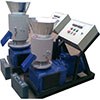
Differences and Usage Methods Between Flat Die Wood Pellet Mills and Vertical Ring Die Wood Pellet MillsIn the biomass densification industry, choosing the correct pelletization equipment is critical for operational efficiency, pellet quality, and equipment lifespan. Among the most widely used machines are Flat Die Wood Pellet Mills and Vertical Ring Die Wood Pellet Mills. While both compress raw biomass into standardized fuel pellets, their structural designs, mechanical behaviors, and ideal operational contexts differ significantly.1. Key Structural DifferencesParameter / FeatureFlat Die Wood Pellet MillVertical Ring Die Wood Pellet MillDie OrientationHorizontal flat plateVertical stationary ringFeeding MechanismGravity-fed from top directly onto die surfaceCentrifugal force combined with gravity feedingMain Moving ComponentRollers rotate on fixed die (or flat die rotates under fixed rollers)Rollers rotate inside a stationary ring diePressure DistributionUneven linear speed (inner vs. outer edge of die)Uniform rotational force and continuous compressionHeat DissipationOpen chamber design; moderate heat dissipationBuilt-in cooling air channels; higher heat dissipation efficiencyThroughput Capacity50 kg/h – 1.5 tons/h (Small to Medium scale)1.0 ton/h – 5+ tons/h per unit (Industrial scale)2. Core Operational & Functional DifferencesFlat Die Pellet MillsMechanical Dynamics: Raw material falls vertically into the pressing chamber. As the rollers travel in a circular path over the flat die surface, the linear velocity at the outer edge of the roller is higher than at the inner edge. This creates natural shear forces and extra friction, which helps grind down rough, fibrous materials before pressing them through the die holes.Material Suitability: Ideal for softwoods, agricultural residues (straw, rice husk), organic fertilizers, and small-scale hardwood processing.Footprint & Maintenance: Compact design, fewer complex transmission components, lower initial investment, and straightforward die/roller replacement.Vertical Ring Die Pellet MillsMechanical Dynamics: Raw material enters vertically into the center of the pelletizing chamber. The high-speed rotation of the roller assembly generates centrifugal force, flinging material evenly around the inner circumference of the stationary vertical die. Rollers compress the material outward into the horizontal die holes.Material Suitability: Built specifically for dense, high-lignin, hard-to-compress materials such as hardwood sawdust, bark, forest logging residues, and abrasive biomass fibers.Efficiency & Stability: Continuous, balanced forces prevent material bridging. Built-in forced-air cooling systems lower chamber temperatures, preventing premature wear and die clogging during continuous 24/7 operations.3. Usage Methods and Operational GuidelinesA. Material Preparation (Applicable to Both Types)Moisture Content Control: Maintain raw material moisture strictly between 12% and 18%. Moisture above 18% causes soft, unstable pellets and clogging; moisture below 10% generates excessive friction and thermal degradation.Particle Size Management: Feedstock particle size must not exceed 2/3 of the target pellet diameter (typically ≤4–6 mm for standard 6–8 mm pellets).B. Operating a Flat Die Wood Pellet Mill1.Pre-Start Inspection & Lubrication:Verify mechanical integrity before applying power。Inspect roller-to-die clearance (standard gap: 0.1 mm – 0.3 mm). Lubricate roller bearings with high-temperature grease.2.Die Seasoning (Oiling Process):Crucial for new or stored dies。Mix sawdust, fine sand (3–5%), and waste oil (10–15%). Feed this mixture repeatedly through the machine for 10–15 minutes to polish die holes and prevent clogging.3.Feeding & Production:Control rate based on motor load。Start the motor empty, then gradually introduce raw material. Monitor current draw; avoid sudden overfeeding to prevent thermal tripping or belt slippage.4.Shutdown Procedure:Prevent material hardening inside die holes。Stop raw material feed 3–5 minutes prior to shutdown. Run an oily sawdust mixture through the machine so die holes remain filled with soft, lubricated material during downtime.C. Operating a Vertical Ring Die Wood Pellet Mill1.System Integration Check:Confirm all auxiliary equipment is operational。Ensure the forced-air cooling fan, dust collection cyclone, automatic lubrication system, and feed auger are powered and functional.2.Roller Gap Adjustment:Maintains symmetrical pressure on the ring die。Adjust the clearance between the twin rollers and the inner wall of the ring die using the adjusting bolts (optimal clearance: 0.2 mm – 0.5 mm).3.Controlled Startup & Feeding:Variable speed drive regulation。Start main drive motor, engage air extraction fan, and initiate the feeder auger at a low frequency (Hz). Gradually increase feed speed as the temperature in the pelletizing chamber reaches target operating level (70°C – 90°C).4.Real-Time Monitoring & Shutdown:Industrial continuous operation protocol。Monitor oil temperature, bearing temperature sensors, and ammeter readings. At cycle completion, purge the die with oily feedstock before turning off main power.4. Selection CriteriaChoose a Flat Die Mill if your project requires modest output (<1.5 t/h), lower capital expenditure, mobile operation, or processes varied biomass/fertilizer materials.Choose a Vertical Ring Die Mill for large-scale industrial wood pellet production, handling tough hardwood sawdust, continuous multi-shift operations, and demanding pellet density standards.